Initiatives
From Building Products to Building Businesses: What Roburna Builders Wants to Help Founders Achieve
Roburna Builders wants to help founders turn a working product into a real business, from validating the problem and finding first users to generating revenue and growing sustainably.
10/24/2026 · 6 min read
By Alcalde · October 24, 2026
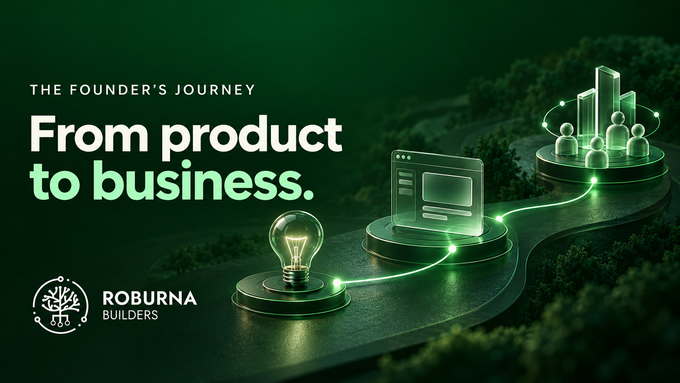
An idea can become an application.
An application can become a product.
But turning that product into a business requires a different set of decisions, skills, and sustained effort.
Founders must understand the problem they are solving, determine whether people need their solution, find their first users, establish a way to generate revenue, and work out how the business can continue to grow.
These are challenges Roburna Builders wants to help people navigate.
Its goal is not simply to encourage more people to start projects, but to support builders as they work towards creating products and businesses with real-world value.
The Journey Does Not End at Launch
During a Roburna Builders community Space, Rex outlined the different stages involved in building a business:
\- validating an idea,
\- developing a minimum viable product (MVP),
\- launching it,
\- acquiring users,
\- generating revenue,
\- and pursuing sustainable growth.
Each stage introduces new questions.
An idea might sound promising, but will people actually use the product? An MVP might demonstrate that a solution works, but does it solve a problem people care enough about to adopt? Even after launch, a founder still needs to understand how to attract users, retain them, and build a business model that can support continued development.
As Rex explained during the discussion:
"Building an application is not necessarily building a business. Launching a website is not necessarily building a business either."
The distinction is important because completing a product is only one part of the process. A working application does not automatically establish demand, create a customer base, or generate revenue.
For founders, this means thinking beyond what they want to build and considering what it will take for people to use it, benefit from it, and keep coming back.
Start With the Problem, Not the Technology
For people building within blockchain ecosystems, there can be a temptation to begin with the technology and then search for a problem it can solve.
The discussion around Roburna Builders pointed towards a different approach:
Understand the business problem first, then determine whether blockchain is an appropriate part of the solution.
Not every product needs to be built on a blockchain. The technology should serve a meaningful purpose within the product rather than become the reason for building it in the first place.
This approach encourages founders to ask practical questions early.
Who needs this solution? What problem does it address? How are people dealing with that problem today? What would make them choose this product instead?
These questions can help founders assess an idea before committing substantial time and resources to development.
They also keep the focus on the people who will eventually use the product. The objective is not simply to build something that works technically, but to create something useful enough to attract and retain an audience.
Finding Users Is Part of Building the Business
One of the challenges raised during the Space was the gap between developing a good product and getting people to discover it.
Lars, founder of Roburna Labs, highlighted the difficulty of generating revenue from a quality product that nobody sees. FoxySwap also raised the issue of marketing, noting that developers can be strong at building products while struggling to promote them.
For a founder, this creates a problem that cannot be solved through development alone.
A product needs to reach the people it was designed for. Those people need to understand what it does, why it matters, and how it can help them. The team must then find ways to turn awareness into actual usage and, where appropriate, paying customers.
Marketing is therefore not something to consider only after development is complete. It is part of the wider process of bringing a business to life.
This does not mean every founder must become an expert in every discipline. It means recognising where expertise is needed and finding ways to bring it into the business.
A technically capable founder may need help with positioning, communications, customer acquisition, or business development. Another may need support refining the product or understanding its market. Knowing where those gaps exist is an important part of moving forward.
Building a Business Requires More Than One Skill Set
Founders often begin with limited resources and a small team, sometimes consisting of just one person. As a product develops, however, the demands on that team can expand.
A developer may be responsible for the product itself but also need to think about user experience, marketing, customer relationships, operations, and revenue. Trying to manage every responsibility alone can become difficult.
This is one reason Roburna Builders is intended to bring people with different skills into the same ecosystem.
During the Space, Rex discussed how developers, designers, marketers, content creators, product managers, and other contributors can work together around projects.
Someone with a business idea does not necessarily need to possess every skill required to bring it to life. Likewise, someone with valuable skills does not need to have their own project before they can contribute to building one.
The objective is to make it easier for people to find collaborators, exchange knowledge, and form working relationships around shared goals.
For founders, those connections can help address gaps that would otherwise slow their progress. For contributors, they can create opportunities to apply their skills to real projects.
Roburna Builders provides the environment for these connections, while the people involved establish their own working arrangements and agreements.
Support for the Work Beyond Development
The Roburna Builders approach extends beyond connecting people. During the Space, the team discussed workshops, sessions with experienced professionals, partner resources, and access to services that could help builders address technical and business challenges.
These resources are intended to support people as their needs evolve.
A founder working on an early idea may need guidance on validating the problem. Someone developing an MVP may need technical input or help identifying the right tools. A team preparing to launch may need to improve its messaging, reach potential users, or understand business and regulatory considerations relevant to its product.
The support required will differ from one project to another. The intention is to give builders access to resources, knowledge, and connections that can help them make more informed decisions as they progress.
Lars also discussed plans to bring professional marketers and other experts into the ecosystem, alongside initiatives intended to increase the visibility of builders and their work through publications and public relations.
A Place to Keep Building
Roburna Builders brings together people at different points in the building process. Some may be exploring an idea, others may already have a working product, and some may be trying to grow an existing project into a more established business.
They will not all need the same things, and their paths will not necessarily look alike.
What connects them is the work of moving from an initial idea towards something useful, adopted, and capable of growing.
The team has encouraged builders to create profiles, share their progress, and communicate when they need help. This is part of the intended role of the ecosystem: to give people a place to demonstrate what they are working on, learn from others, and potentially find the expertise or connections they need for their next stage.
For founders, progress also means recognising that business development does not stop when the product launches. There will be new questions about users, revenue, partnerships, and growth. Each stage requires attention and a willingness to keep learning.
Roburna Builders wants to support that longer journey.
The goal is not just to help people build a product. It is to help them work towards building something people need, use, and are willing to support.