Projects
Building for Real-World Problems: Meet the Projects Taking Shape Around Roburna Builders
The best innovations come from firsthand experience with a problem, whether it is an operational inefficiency in business or a daily personal frustration. True entrepreneurial opportunity lies in bridging these gaps, and transforming a personal frustration into a practical, scalable solution that creates value for others.
10/26/2026 · 5 min read
By Alcalde · October 26, 2026
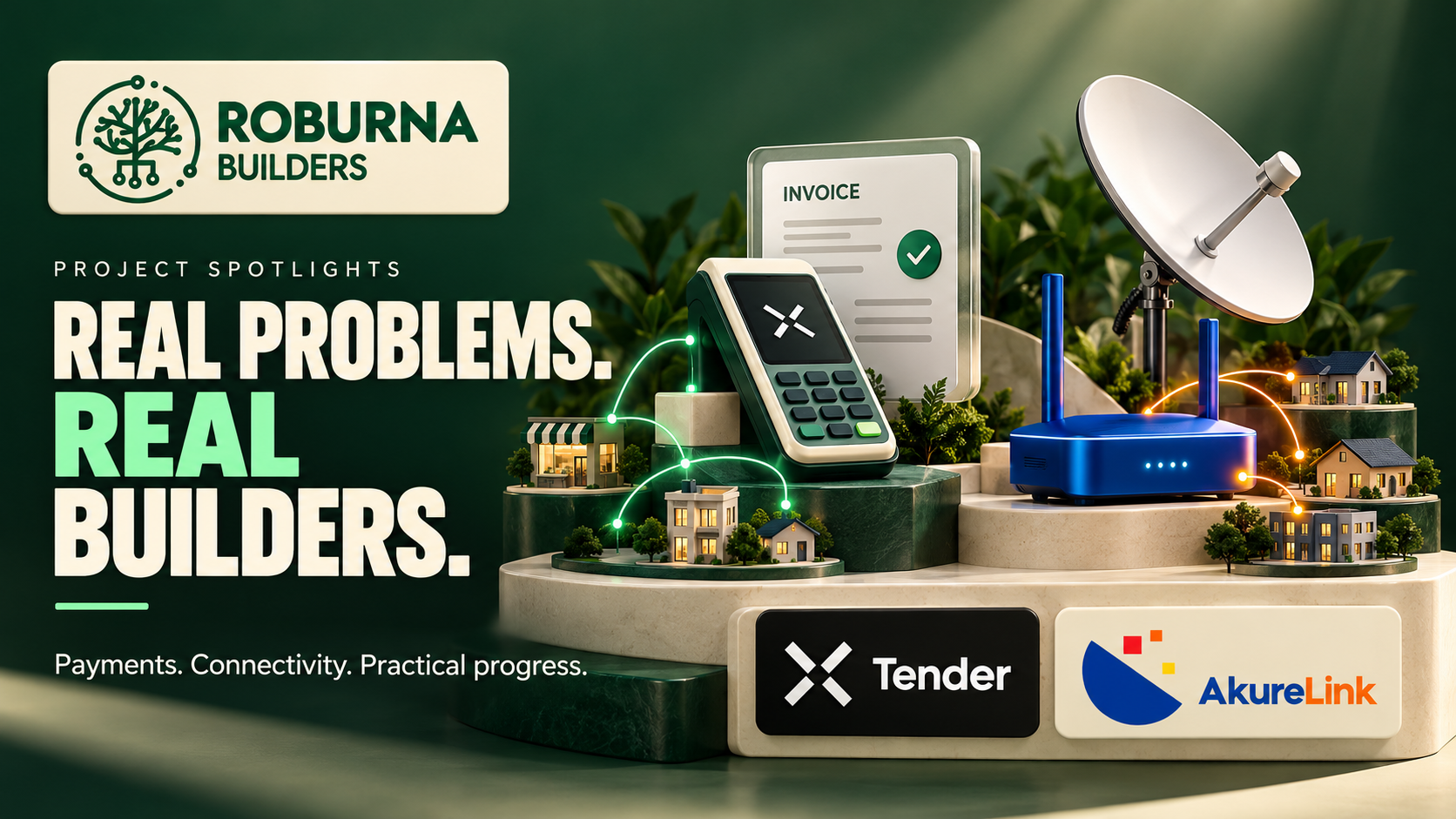
Across the Roburna Builders ecosystem, projects are emerging from different experiences, industries, and ideas. Two examples are Tender, a crypto payment platform designed to simplify how merchants receive payments, and AkureLink, a connectivity business exploring ways to make reliable internet access and network management more accessible.
Their approaches are different, but both reflect an important part of building: identifying a practical need and working towards a solution.
Tender: Making Crypto Payments More Practical for Businesses
Accepting cryptocurrency can introduce complexity for businesses. Customers may use different assets across different networks, while merchants need a clear way to track payments and manage the funds they receive.
Tender is being developed to address this challenge.
The platform allows merchants to create payment links and invoices, track payment status, and receive payments initiated across supported cryptocurrency networks, with settlement directed to a chosen network.
As Dami, the project's founder, explained during a Roburna Builders community discussion, the vision is to “receive payments on any coin and settle on a particular chain.”
The idea is to make cryptocurrency payments easier to integrate into business operations, rather than requiring merchants to manage every network independently.
Tender also includes a developer mode, allowing developers to integrate its payment functionality into their own products and websites. Its invoice system is designed to help merchants identify incoming payments and distinguish between completed, underpaid, and overpaid invoices.
At the time of the discussion, Dami reported that Tender was already live, with more than 30 sign-ups and over $200 in transaction volume. These were early figures, but they showed that the project had moved beyond an idea and was beginning to attract users.
There are still challenges to work through. During the discussion, participants raised questions about transaction costs, especially for smaller payments, as well as the implications of expanding into different markets. Dami acknowledged that reducing the impact of fees remains an area of work. He also explained that Tender itself was not charging transaction fees at that stage, although fees from the underlying payment infrastructure could still apply.
These are the kinds of questions that become important as a product moves from development towards wider adoption. A payment solution must do more than function technically. It must also make sense for the businesses expected to use it.
For Tender, the next steps include attracting more merchants, continuing to improve the service, and exploring how its business model can develop over time.
AkureLink: Addressing Internet Access and Network Management
For Timi, the founder of AkureLink, the starting point was closer to home.
Unreliable internet access in his area led him to explore ways of providing more dependable connectivity. Rather than relying only on conventional internet service arrangements, AkureLink uses physical networking infrastructure to distribute connectivity to locations that need it.
The service can involve Starlink equipment, point-to-point radios, antennas, routers, switches, and access points. Depending on the customer's needs, the setup can support business locations, cybercafés, technology events, hackathons, and other environments where a stable shared connection is important.
AkureLink can help customers acquire and configure the equipment, establish their network, and manage the technical setup. Equipment can also be rented for temporary needs, such as events.
But Timi sees an opportunity beyond providing the infrastructure itself.
Setting up a shared internet network can require significant technical work. Users may need to rent a server, install software, configure routers, manage bandwidth, control access, and establish firewall rules. For someone without a technical background, these steps can become a major barrier.
Timi experienced this process himself before developing AkureLink. Reflecting on the time he spent learning to configure the system, he described the idea that motivated his next step:
“There should be a way I can make this easy for people to set up by themselves without other hassle.”
That idea is the basis for a planned software-as-a-service offering that would simplify network setup and management. The goal is to help users perform tasks that might otherwise take hours in a matter of minutes, without having to work through every technical step manually.
The software is still being considered, rather than presented as an already launched product. AkureLink's existing work centres on physical connectivity services, while the proposed software could eventually make those capabilities easier for more people to access.
The discussion also highlighted the practical realities behind the opportunity. Equipment costs, electricity, security, and affordability all affect how reliable connectivity can be delivered. Timi noted that the initial cost of setting up a service can put it beyond the reach of some households, even when several people could benefit from sharing the connection.
Possible approaches include serving multiple households, working with property owners, and developing arrangements that make the infrastructure more affordable to maintain.
These considerations are central to AkureLink's challenge: providing a useful service requires not only the right technology, but also a model that works within the conditions of the communities it serves.
Different Projects, A Shared Approach to Building
Tender and AkureLink operate in different areas. One is working on cryptocurrency payments; the other is addressing internet connectivity and network management.
Yet both demonstrate how projects can develop from specific problems rather than abstract ideas.
Tender is working to make it easier for businesses to accept payments across multiple networks. AkureLink is providing connectivity services while exploring how software could reduce the technical burden of setting up and managing shared internet infrastructure.
Neither project is without questions to resolve. Payment costs, merchant adoption, pricing, equipment investment, and service delivery all require continued attention. That is part of the building process: testing assumptions, listening to feedback, and identifying what needs to improve.
These questions also show why a builder's journey benefits from more than working in isolation.
Where Roburna Builders Comes In
Roburna Builders provides a space for founders and creators to introduce their work, share progress, exchange ideas, and connect with people who may offer useful perspectives or complementary skills.
In the discussion that brought Tender and AkureLink into the same conversation, project presentations developed into practical questions about business models, potential customers, technical challenges, and future opportunities. Dami also expressed interest in finding ways to work with other participants, while the conversation opened the door to further connections.
Those interactions matter because building a product is rarely just about developing its core technology. Founders must also understand their users, make difficult decisions, communicate their ideas, and find people who can help them move forward.
Roburna Builders aims to make those parts of the journey more visible and create opportunities for builders to learn from one another as their projects evolve.
Tender and AkureLink offer two examples of that work in progress. Their stories are still developing, but they already show the range of problems builders are working to solve and the value of bringing those builders into conversation with one another.
As these projects continue to develop, their progress will be worth following, not simply for what they are building today, but for what they may become as they test their ideas, reach more users, and turn early work into practical services.