Events
Beyond Networking: Building an Ecosystem Where People Grow Together
A builder ecosystem becomes more valuable when connections lead to something practical. Meeting other founders, developers, designers, and creators is a useful starting point.
10/29/2026 · 5 min read
By Alcalde · October 29, 2026
A builder ecosystem becomes more valuable when connections lead to something practical.
Meeting other founders, developers, designers, and creators is a useful starting point. But the real opportunity comes when those connections develop into shared learning, honest feedback, collaboration, and the exchange of skills that help people move their work forward.
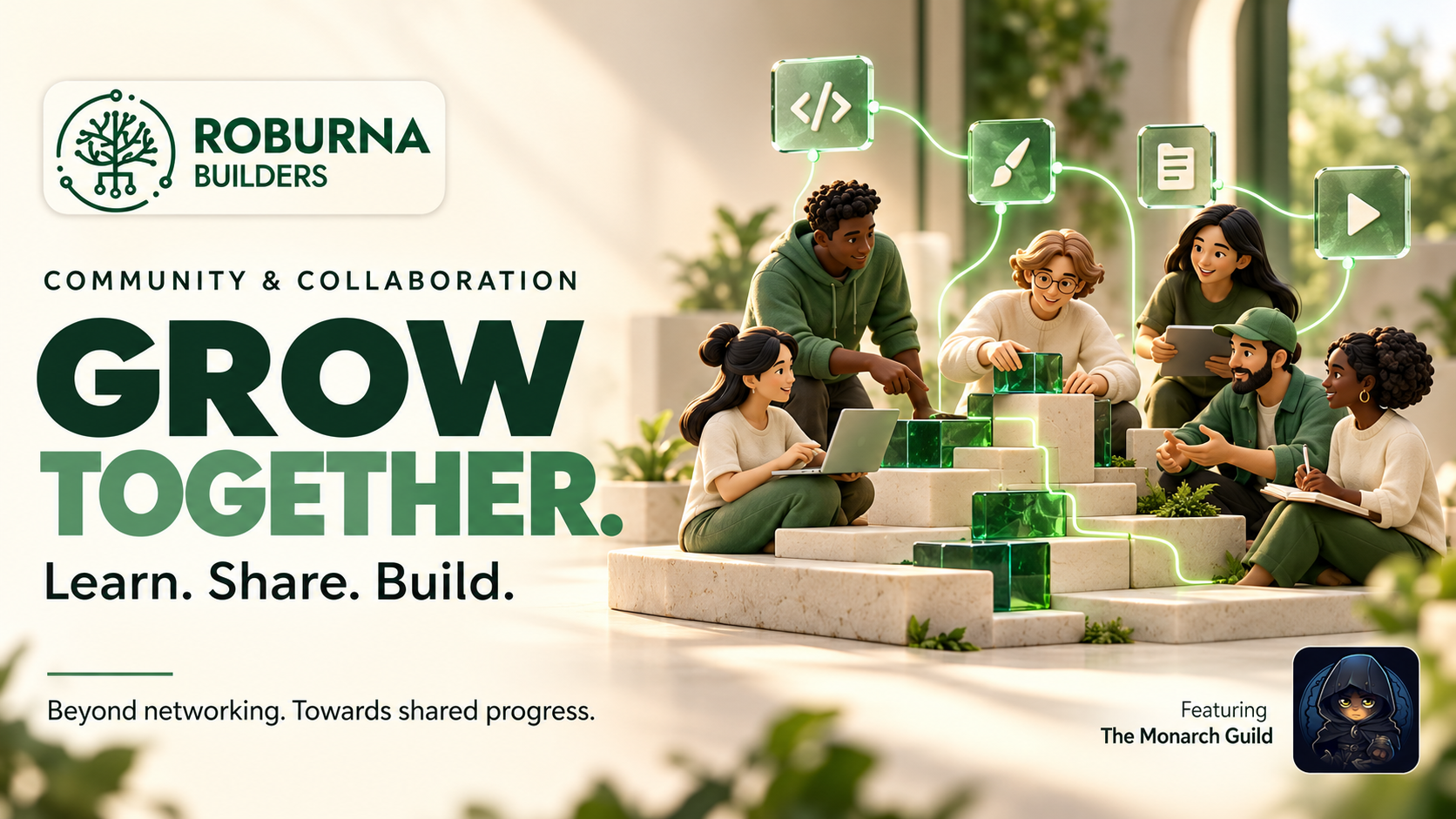
This is an important part of what Roburna Builders is working to encourage: a community where people can do more than introduce their projects. They can learn from one another, share what they discover, and build relationships that continue beyond a single conversation.
From Introductions to Shared Progress
Builders often face challenges that extend beyond their main area of expertise.
A founder may understand the product they want to build but need help with marketing. A developer may have the technical skills to create a solution but struggle to find users. A designer may have valuable experience that another team needs, while a community manager may have learned practical lessons that could save someone else time.
These skills are often distributed across different people and projects. An active ecosystem creates opportunities for that knowledge to move between them.
During a recent Roburna Builders Open Session, Emmanuel introduced The Monarch Guild, a platform designed to go beyond job seeking by helping people connect with others in their professional fields.
The idea is to create a community where members can exchange experiences, share ideas, learn from one another, and continue developing their skills as their industries evolve. Rather than focusing solely on finding work, The Monarch Guild aims to help people grow through meaningful professional connections.
Small Groups, Shared Goals, and Continuous Learning
One practical suggestion raised during the discussion was to organise people into smaller groups based on their skills and interests.
Social media managers could work together on campaigns and share what they learn about changing platform algorithms. Designers could exchange techniques and review one another's work. Builders could discuss challenges, compare approaches, and learn from their experiences.
Rather than meeting only when there is an announcement or event, these groups could establish recurring sessions, set weekly milestones, and work towards common goals.
As the discussion suggested, a group of social media managers might challenge themselves to get a video or post trending, then share the methods and lessons they discovered along the way.
The value would not depend entirely on whether every attempt succeeded. Participants would have an opportunity to learn through practice, understand what worked, and carry those lessons into their next effort.
This approach also recognises that learning in a fast-moving industry is continuous. Techniques that work today may need to change tomorrow. Sharing current experiences can help people adapt more quickly than they might by working alone.
For Roburna Builders, this offers a practical direction for community development: move beyond bringing people into the same space and create more opportunities for them to work towards shared outcomes.
Different Skills Make the Ecosystem Stronger
A healthy builder ecosystem needs more than developers.
Products also need design, research, writing, video production, marketing, community management, onboarding, and other forms of support. The people contributing these skills may not always identify themselves as traditional Web3 builders, but their work can be essential to a project's growth.
The discussion highlighted this diversity, pointing to the different roles people play in Web3 communities, from technical development and UX design to storytelling, writing, and video creation.
Recognising these contributions expands the possibilities for collaboration.
A founder working on a product may find someone who can improve its presentation. A creator may discover a project that needs their skills. A developer may connect with someone who understands the audience they are trying to reach.
These relationships can develop naturally when people have regular opportunities to share their work, discuss challenges, and understand what others are building.
The aim is not to make everyone work on the same thing. It is to make it easier for people with different strengths to find common ground.
Feedback Is Part of Building
The same principle applies to project discussions.
When builders present what they are working on, the conversation can become an opportunity to examine assumptions, identify challenges, and consider possibilities they may not have explored.
In the community discussion, project presentations led to questions about costs, potential customers, technical implementation, and business models. Participants were encouraged to continue conversations, connect directly, and explore whether their work could complement one another.
This kind of exchange can be useful even when it does not immediately result in a partnership.
A question can expose a gap in a product's thinking. A suggestion can reveal a new customer segment. A conversation with someone working in a related field can help a founder see a challenge from a different perspective.
The important part is creating an environment where builders can explain what they are doing, receive thoughtful responses, and keep developing their ideas.
Making Connections Continue Beyond the Conversation
A single event can introduce people to one another, but sustained collaboration usually requires a way to keep those relationships active.
During the discussion, participants expressed interest in working together, and the host proposed smaller team-building sessions where they could reconnect and explore possible collaborations. Joining the community was also presented as a way to keep communication going beyond the live conversation.
These are early steps towards a more connected ecosystem. They create opportunities for introductions to become ongoing discussions and for shared interests to develop into practical work.
Not every connection will lead to a collaboration, and not every idea will become a project. But consistent opportunities to interact make it easier for useful relationships to emerge.
Growing an Ecosystem Through Participation
Ecosystem development is not measured only by the number of people who join a platform or attend an event. It also depends on what those people are able to do once they are there.
Can they find others who understand their challenges? Can they share what they have learned? Can they get feedback on their work, discover complementary skills, and build relationships that help them make progress?
These are the kinds of questions that matter as Roburna Builders develops its community.
The opportunity is to make participation useful at different stages of the building journey, whether someone is exploring an early idea, developing a product, improving their skills, or looking for people to work with.
By encouraging shared learning, practical feedback, and continued connections, Roburna Builders can help create an environment where progress is not limited to individual projects. The people involved can learn from one another, strengthen their capabilities, and contribute to a more connected ecosystem.
Because building is rarely a solitary process. The right community does not simply give people somewhere to meet. It gives them more opportunities to learn, contribute, and move forward together.